

How Do Digital Signal Processing and Diagnostics Improve Flow Transmitter Boards in 2026?
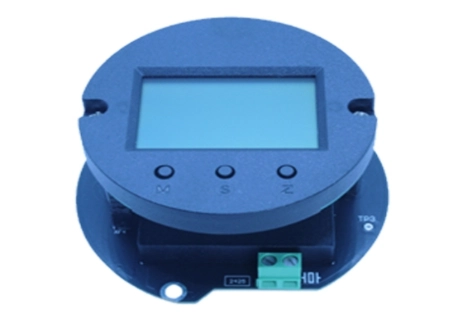
In 2026, industrial instrument manufacturers face higher demands for accuracy, communication, fault detection, and application flexibility. These demands are especially important in petrochemical plants, chemical processing lines, wastewater systems, and facilities handling toxic, corrosive, flammable, or explosive media.
When engineers choose an electromagnetic flowmeter, they often focus on the sensor tube, liner, electrode material, and process connection. However, the measurement quality also depends heavily on the electronics inside the instrument. The flow transmitter board is responsible for exciting the sensor, collecting weak signals, filtering interference, calculating flow, and sending reliable data to a control system.
ICwalk focuses on this electronic core. Our flow transmitter board range helps instrument manufacturers develop complete meters around their own sensors, housings, process connections, and application requirements.
Why does the transmitter board matter in modern flow measurement?
A complete flowmeter includes mechanical, electrical, and software components. The sensor interacts with the liquid, but the transmitter board converts that physical response into useful industrial data. This makes the board a key part of the measurement chain.
Before discussing individual functions, it is useful to see the board from an OEM perspective. Instrument manufacturers are not simply buying a small circuit. They are integrating a measurement engine that must match the sensor, power supply, communication system, display, enclosure, and operating environment.
The board is the electronic core
An electromagnetic flowmeter measures conductive liquids by detecting a small voltage generated as the liquid moves through a magnetic field. The signal may be very weak, while industrial equipment nearby can produce strong electrical interference.
A reliable flow transmitter board normally performs several tasks:
- drives the electromagnetic excitation coil
- receives and amplifies the electrode signal
- filters electrical noise
- converts the signal into digital data
- applies calibration and linear correction
- calculates flow rate and total flow
- monitors sensor and circuit conditions
- provides 4-20 mA, pulse, frequency, Modbus, or HART outputs
This is why a transmitter circuit, Transmitter PCBA, or Sensor Signal Conditioning Board can strongly affect the final instrument’s stability and accuracy.
Why electromagnetic measurement suits demanding liquids
An electromagnetic flowmeter has no moving parts inside the flow path. This can be useful for conductive water-based chemicals, wastewater, acids, alkalis, slurries, and other process liquids where mechanical wear or blockage may be a concern.
However, the finished meter still requires correct liner and electrode selection. Corrosion resistance depends on wetted materials, temperature, pressure, seals, and chemical compatibility. The electronics support the measurement, but they do not replace proper mechanical design.
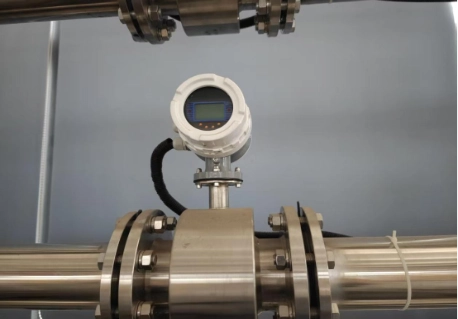
How does digital signal processing improve measurement quality?
Digital signal processing helps the transmitter separate the useful flow signal from electrical noise, offset, unstable grounding, and changing process conditions. In 2026, this function is becoming more important as plants add more drives, remote instruments, wireless systems, and automated control equipment.
The E4000 platform combines analog measurement circuits, digital algorithms, calibration functions, and communication interfaces in one board architecture. This product has low-frequency excitation, small-flow correction, empty-pipe detection, multiple outputs, and data backup functions.
Separating weak signals from industrial noise
The electrode signal in an electromagnetic flowmeter is small. Nearby pumps, variable-frequency drives, motors, long cables, and switching power supplies can introduce unwanted signals.
Good signal processing helps by:
- rejecting common-mode interference
- filtering power-frequency noise
- reducing high-frequency disturbances
- stabilizing the zero point
- improving low-flow response
- preventing false readings during electrical disturbances
A high-resolution converter alone cannot solve every measurement problem. The circuit layout, grounding, excitation waveform, amplifier design, software filters, and sensor matching must work together.
For this reason, ICwalk boards are designed as more than simple converters. They combine a process control board, process control board transmitter functions, and measurement software into an integrated circuit module.
Maintaining accuracy across changing flow conditions
Real process flow is rarely constant. A plant may operate at low flow during startup, higher flow during production, and variable flow during batching or cleaning.
Digital correction functions can help maintain stable performance across this range. The E4000 supports a flow velocity range of 0.1 to 15 meters per second, 1 millimeter per second resolution, and four-point small-flow linear correction. Its published accuracy depends on pipe diameter and flow velocity, so OEMs should evaluate the complete sensor and transmitter combination rather than relying on one general accuracy figure.
This flexibility is valuable for chemical dosing, wastewater transfer, liquid batching, and other applications where low-flow performance matters.
How do diagnostics make a flow transmitter more reliable?
A flowmeter should not only report a number. It should also help users understand whether that number is trustworthy.
A measurement that looks normal but is affected by an empty pipe, broken excitation cable, coated electrode, or unstable signal can create serious process problems. Flow diagnostics give operators and maintenance teams more information before a small fault becomes a production event.
Detecting sensor and wiring problems
A modern board may monitor:
- empty-pipe conditions
- excitation faults
- excitation drive problems
- upper and lower flow limits
- sensor wire breaks
- abnormal signal levels
- communication errors
- data loss or configuration changes
The E4000 includes empty-pipe detection without an additional electrode, excitation alarms, upper and lower limit alarms, three totalizers, and data backup and recovery functions.
These features support preventive maintenance. They also help engineers distinguish between a real process change and a measurement problem.
Supporting safer industrial operation
In petrochemical and chemical environments, a transmitter board may be installed inside an instrument used near toxic, corrosive, flammable, or explosive media. The board can contribute through stable signal processing, isolated outputs, low-power architecture, and fault monitoring.
At the same time, a bare board should not be described as an explosion-proof flowmeter. Hazardous-area suitability depends on the complete certified instrument, enclosure, wiring, energy limits, temperature rating, installation method, and regional requirements.
The final instrument manufacturer remains responsible for selecting compatible materials and completing the required system-level assessment.
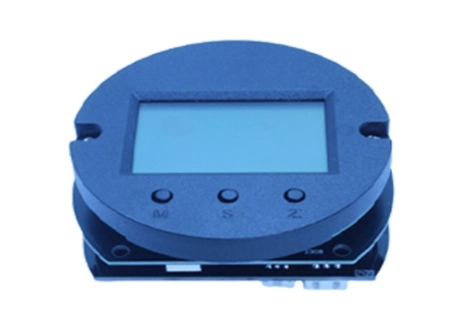
What communication functions should OEMs consider in 2026?
A flow transmitter must connect with the plant’s control and maintenance systems. The best interface depends on the application, cable distance, control architecture, and required diagnostic depth.
A 4-20mA Transmitter Board remains useful for conventional control loops. Pulse and frequency outputs can support total flow and batching. RS485 with Modbus RTU may be suitable for digital networks, while a HART Protocol Module can add configuration and diagnostic access without removing the analog loop.
The E4000 supports 4-20 mA output, configurable frequency and pulse outputs, RS232 or RS485 communication, Modbus RTU, and optional HART communication.
For field service, compatibility with a hart 375 communicator can also be valuable when the finished instrument uses HART communication. A clear manual should explain wiring, parameter settings, sensor matching, output configuration, fault codes, and communication procedures.
Why instrument manufacturers choose ICwalk boards
Instrument manufacturers often have strong mechanical engineering capabilities. They may already understand process connections, pipe structures, liners, electrodes, housings, and installation requirements. The difficult part is building stable signal processing and communication electronics from the beginning.
Why Instrument Manufacturers Choose ICwalk Boards
We solve the complex signal processing and HART communication challenges, allowing you to focus on mechanical design and process connections.
Our support can help OEMs shorten development work by starting with a tested electronic platform. Depending on the project, we can discuss:
- output type and communication options
- integrated or split transmitter structures
- sensor excitation matching
- display and language requirements
- firmware behavior
- alarm functions
- power supply design
- custom circuit interfaces
- application-specific calibration
ICwalk has operated since 2007 and serves customers in more than 50 countries with OEM components and intelligent process control solutions.
How should OEMs evaluate a flow transmitter board?
Before selecting a board, engineers should review the complete integration conditions. Important questions include:
- Is the sensor suitable for the liquid’s conductivity and chemical properties?
- Does the excitation current match the sensor coil?
- Is the signal processing stable at low flow?
- Are the required 4-20 mA, pulse, frequency, Modbus, or HART outputs available?
- Can the board provide useful flow diagnostics?
- Is the power supply suitable for the enclosure and installation?
- Are isolation, grounding, and EMC requirements covered?
- Can the board be customized for the finished instrument?
- Does the supplier provide a clear manual and technical support?
El E4000 electromagnetic flow transmitter board offers a practical starting point for OEMs developing electromagnetic flowmeters for conductive liquid applications.
Conclusión
In 2026, a flow transmitter board is much more than a signal converter. It is the electronic core that determines how accurately a flowmeter reads, how quickly it responds, how well it rejects industrial noise, and how clearly it reports faults.
For electromagnetic flowmeters used with chemical, petrochemical, wastewater, and other demanding liquids, digital signal processing and diagnostics are essential. They help transform weak sensor signals into stable process data while giving operators better information about abnormal conditions.
ICwalk does not manufacture the complete flowmeter. We provide the transmitter PCBA, circuit module, and related electronics that instrument manufacturers can integrate into their own designs. With the right board, OEMs can focus on sensors, process connections, enclosures, and application engineering while building a more reliable finished instrument.
FAQs
Q: What does a flow transmitter board do?
A: It conditions sensor signals, calculates flow, runs diagnostics, and sends data through analog or digital outputs.
Pregunta: Can the E4000 support HART communication?
A: Yes, the E4000 can be customized with HART communication for configuration and diagnostics.
Pregunta: Can it display liters or kilograms?
A: Liters are direct flow units; kilograms require density data in the finished instrument.


