

What should you look for in a chemical flow meter for corrosive liquids in 2026?
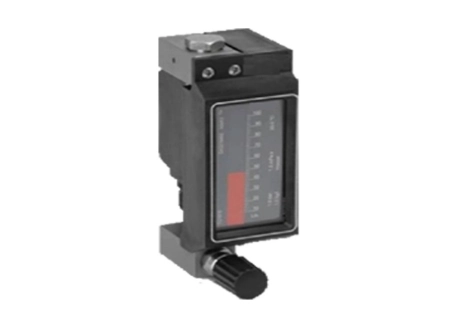
In chemical plants, oil and gas facilities, and wastewater systems, flow measurement is rarely a simple matter of reading how much liquid passes through a pipe. The medium may be corrosive, toxic, conductive, contaminated, or difficult to handle. A reliable chemical flow meter must provide accurate data while supporting stable operation in demanding environments.
For conductive corrosive liquid flow, an electromagnetic flow meter is often a strong starting point. However, the sensor and meter body are only part of the measurement system. The electronics inside the instrument determine how weak signals are collected, filtered, calculated, displayed, and sent to a control system.
Em ICwalk, we focus on this critical electronic layer. We provide OEM transmitter boards and intelligent modules. Our flow transmitter board range is designed to help flow meter manufacturers and system integrators build accurate, stable, and application-specific instruments.
Why is an electromagnetic flow meter suitable for corrosive liquids?
An electromagnetic flow meter works by detecting the voltage created when a conductive liquid moves through a magnetic field. Because the measurement does not depend on mechanical movement inside the pipe, there is no rotor or turbine that can easily wear, block, or lose accuracy during long-term use.
This makes the technology attractive for many chemical flow meter applications. It can be used with water-based chemicals, acids, alkalis, slurries, wastewater, and other conductive media when the wetted materials are selected correctly.
When conductivity matters
The first question is not whether an electromagnetic flow meter looks suitable. It is whether the liquid has enough electrical conductivity for the sensor to produce a reliable signal.
For a chemical plant, the selection process should include:
- Liquid conductivity
- Fluid temperature
- Pressure and pipe size
- Corrosive properties
- Solid particle content
- Flow velocity
- Required accuracy
- Required output and communication protocol
For corrosive liquid flow, the lining and electrode materials still matter greatly. The transmitter board cannot compensate for an unsuitable sensor body. The complete measuring point must be designed as one system.
When the process liquid is conductive, an electromagnetic flow meter can provide stable volumetric measurement without placing moving parts in direct contact with the fluid. This can reduce mechanical wear and simplify long-term maintenance.
How does it compare with other flow meter types?
Different flow meter technologies are better suited to different media. A rotor flow meter may be useful for simple visual indication or low-cost measurement, but moving parts can be less attractive in dirty or corrosive processes.
A vortex flow meter is often considered for steam, gas, and clean liquid applications. A Coriolis flow meter can provide mass flow and density information, but it is usually more complex and costly. An ultrasonic flow meter can be useful where there is no direct contact with the medium or where open-channel measurement is needed.
For conductive corrosive liquid flow, an electromagnetic flow meter is often preferred because:
- It has no internal moving parts.
- It can handle many conductive liquids and slurries.
- It creates little additional pressure loss.
- It supports stable volumetric flow measurement.
- It can be paired with different liners and electrodes.
- Its electronic signal can be adapted to plant control systems.
For non-conductive hydrocarbons, dry gases, or special mass measurement, another technology may be more suitable. Good selection begins with the medium, not with the instrument label.
What role does the flow transmitter board play?
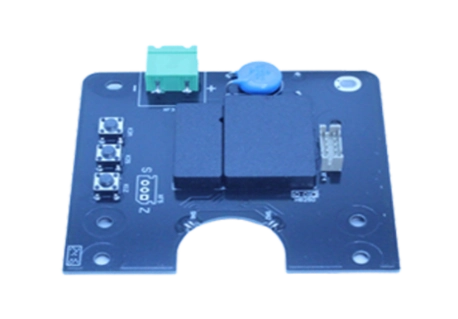
Inside a complete electromagnetic flow meter, the transmitter board is the electronic core. The sensor detects a small process signal, but the board turns that signal into useful measurement data.
The board controls excitation, signal collection, filtering, compensation, calculation, display, alarms, and communication. If the board is unstable, even a well-designed sensor cannot deliver dependable results.
O electromagnetic flow transmitter board E4000 is designed as an OEM component for electromagnetic flow meter manufacturers and integrators. It can work with matching sensors and provide the functions required for industrial measurement systems.
Signal processing is the hidden performance layer
In chemical and petrochemical plants, electrical interference is common. Pumps, motors, frequency converters, long cables, and nearby power equipment can all affect a low-level flow signal.
A capable flow transmitter board should therefore do more than convert an input signal. It should help separate the true flow signal from electrical noise and process disturbance.
Important functions may include:
- Stable sensor excitation
- Low-frequency signal processing
- Empty pipe detection
- Small-flow correction
- Zero-point adjustment
- Range configuration
- Alarm monitoring
- Data backup and recovery
These functions are especially useful when the instrument operates on a remote skid, near rotating equipment, or in a location where frequent manual adjustment is difficult.
Accuracy also depends on the whole system. Sensor matching, pipe conditions, grounding, installation quality, calibration, and board algorithms all influence the final result. The board is not an isolated circuit. It is the decision-making center of the flow meter.
Which outputs are useful in a plant?
A modern chemical flow meter must connect smoothly with the plant’s control and monitoring systems. The output configuration should match the customer’s automation architecture.
Common options include:
- 4-20 mA current output
- RS485 communication
- MODBUS RTU
- Optional HART communication
- Frequency output
- Pulse output
- Local display
- Forward and reverse total flow
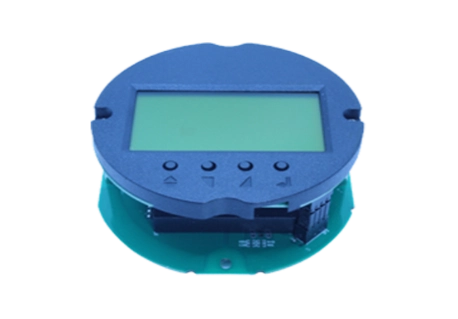
The E4000 series supports 4-20 mA output, RS485 communication with MODBUS RTU, optional HART communication, alarms, totalizers, and data recovery functions. These features allow the final flow meter to serve both local operators and remote control systems.
For example, an operator may need to view instantaneous flow in L/min or m³/h, while the control system records the total flow in liters. In a batch process, a pulse output may be used for dosing control. In a remote plant, digital communication can reduce the need for repeated field checks.
Why does customization matter?
A standard board may work for a general water application, but chemical processes often have special requirements. One customer may need a split-type meter. Another may need a compact display, a different excitation current, a passive output, a special alarm range, or a particular communication method.
Customization may involve:
- Sensor excitation matching
- Output type
- Communication protocol
- Display language
- Alarm values
- Flow range
- Calibration points
- Enclosure or connection design
- Application-specific signal compensation
At ICwalk, we support application-based development and OEM cooperation. Our service solutions cover transmitter board customization, technical support, and product adaptation for different instrument projects.
What should chemical plants check before choosing a board?
A flow transmitter board should be selected together with the process conditions and the final meter design. A technically capable board may still perform poorly if the sensor, power supply, installation method, or communication system is not properly matched.
The most useful evaluation combines electrical performance with practical maintenance needs.
Match the board with the sensor
Before placing an order, confirm:
- Sensor coil resistance
- Required excitation current
- Sensor diameter
- Expected velocity range
- Fluid conductivity
- Power supply type
- Output load
- Environmental temperature
- Required accuracy
The board and sensor must be compatible. Incorrect matching can lead to unstable readings, poor zero performance, or unnecessary alarms.
Plan for hazardous area flow applications
Flammable and explosive environments require special care. A transmitter board by itself does not make a complete flow meter explosion-proof or intrinsically safe.
The final instrument may need suitable enclosure design, wiring protection, grounding, isolation, certification, and installation according to local hazardous-area rules. The sensor, cable, power supply, and board must be evaluated as part of the complete meter assembly.
For this reason, customers should share the application conditions early. At ICwalk, we can discuss the electronic requirements for hazardous area flow projects, while the final meter manufacturer or system integrator remains responsible for the complete certified instrument.
Consider long-term maintenance
A good chemical flow meter should be easy to inspect and restore. Features such as alarm outputs, data backup, parameter recovery, and clear local display can reduce downtime when a process problem occurs.
This is important for toxic or corrosive liquid flow. Operators may not be able to open equipment frequently or spend long periods near the process line. Clear diagnostics help maintenance teams identify whether the issue comes from the sensor, wiring, power supply, empty pipe condition, or transmitter electronics.
How does ICwalk support flow meter manufacturers?
ICwalk has worked in industrial automation and precision instrumentation since 2007. We serve customers in more than 50 countries and provide OEM components and intelligent modules for demanding industrial applications. Our engineering approach combines signal processing, calibration, production control, and application knowledge.
Our E4000 board for electromagnetic flow meters
Our E4000 electromagnetic flow transmitter board is intended for manufacturers and integrators who need a stable electronic core for a complete flow meter.
Depending on the project, the board can support:
- Conductive chemical liquids
- Corrosive process media
- Industrial water and wastewater
- Chemical dosing systems
- Petrochemical process lines
- Remote monitoring systems
- OEM flow meter production
- Customized control and display requirements
The published specifications include a flow velocity range of 0.1-15 m/s, empty pipe detection, multiple output choices, and a basic current output error of 0.1% ±10 μA. Final measurement accuracy depends on the complete sensor and meter design.
What we provide and what we do not
We do not manufacture the complete flow meter body, process sensor, or every finished instrument used in the field. Our focus is the transmitter circuit board and related electronic solution.
That distinction matters. A flow meter manufacturer can use our board as the core of its own instrument, select the right lining and electrode materials, complete the mechanical design, and meet the certification requirements for its market.
We can also help customers review technical details before production. Our case center shows how transmitter board stability, protection, and industrial reliability support different instrument projects.
A practical selection checklist for 2026
Before choosing a chemical flow meter or flow transmitter board, ask these questions:
- Is the liquid conductive?
- Is the liquid corrosive, toxic, abrasive, or mixed with solids?
- Is the process located in a hazardous area?
- What accuracy is required?
- What flow range and pipe diameter are needed?
- Does the customer need L/min, L/h, m³/h, or total liters?
- Is 4-20 mA enough, or is HART or MODBUS required?
- Is a local display necessary?
- Can the board be matched to the selected sensor?
- Is application-specific calibration available?
- Who is responsible for the complete meter certification?
- What support is available after delivery?
These questions help separate a reliable instrument project from a simple component purchase. The best result comes from matching the flow technology, sensor, transmitter board, and final installation conditions.
Conclusão
Choosing a chemical flow meter for corrosive liquids in 2026 requires more than comparing prices or display features. For conductive media, an electromagnetic flow meter can offer a strong balance of accuracy, low wear, and stable volumetric measurement. Yet the transmitter board remains the electronic core that turns a sensor signal into useful process data.
At ICwalk, we focus on this core component. Our E4000 electromagnetic flow transmitter board supports OEM development, signal processing, industrial communication, alarms, total flow calculation, and application-based customization. We do not replace the complete meter manufacturer. We help manufacturers and integrators build a better one. To discuss sensor matching or a custom flow transmitter board, contact our engineering team.
FAQs
Q: Can a chemical flow meter display liters?
A: Yes. It can display L/min, L/h, or m³/h, plus total liters when configured.
Q: Can the flow transmitter board be customized?
A: Yes. We can match sensors, outputs, alarms, protocols, and calibration points to your process.
Q: Is hazardous area flow measurement possible?
A: The final certified meter assembly must meet hazardous-area rules; the board alone is not explosion-proof.


