

What Are the Challenges in Designing a Reliable Flow Transmitter Circuit Module?
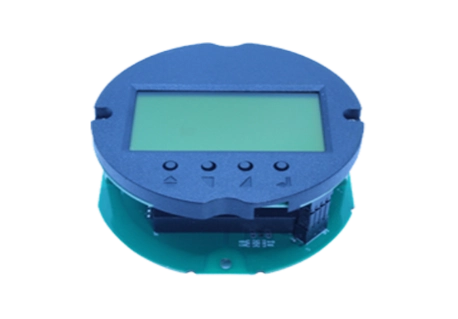
Petrochemical plants and chemical processing sites need dependable flow data. A small error can cause incorrect dosing, wasted material, equipment damage, or an unsafe process condition. The challenge becomes greater when the medium contains toxic chemicals, corrosive liquids, or flammable substances.
For conductive liquids, an electromagnetic flowmeter is often a practical measurement method. It has no moving parts in the measuring tube, and compatible liner and electrode materials can be selected for difficult media. However, the sensor does not produce useful plant data by itself.
The electronic core is the flow transmitter board. It drives the sensor, receives a weak electrical signal, removes interference, calculates flow, detects faults, and sends the result to a control system.
ICwalk manufactures this electronic core rather than the complete flowmeter. Our flow transmitter boards are designed for instrument manufacturers that need a reliable module for their own sensor, housing, process connection, and certified finished product.
Why Choose an Electromagnetic Flowmeter for Difficult Liquids?
Electromagnetic, Coriolis, vortex, ultrasonic, and metal-tube rotor technologies each serve different process conditions. The correct choice depends on the medium, conductivity, flow range, pressure, temperature, pipe size, and required accuracy.
An electromagnetic flowmeter is especially relevant when the process contains electrically conductive liquids. Typical applications include chemical solutions, wastewater, acids, alkalis, slurries, and other water-based media.
Its working principle also creates a clear need for a dependable flow transmitter circuit. When conductive liquid passes through a magnetic field, the electrodes detect a voltage related to flow velocity. That voltage can be extremely small. The circuit must turn it into stable and readable flow data without losing important information.
For this reason, we selected the E4000 electromagnetic flow transmitter board as the product focus for this article.
What Does a Flow Transmitter Board Actually Do?
A complete electromagnetic flowmeter includes a measuring tube, coils, electrodes, liner, process connections, cables, enclosure, display, power system, and electronic module. The flow transmitter board is one component, but it is the component that interprets the sensor.
Its main functions include:
- Supplying controlled excitation current to the sensor coil
- Receiving the differential electrode signal
- Performing signal conditioning and digital conversion
- Applying calibration and low-flow correction
- Detecting empty-pipe and excitation faults
- Calculating instantaneous and total flow
- Sending data through analog or digital outputs
At ICwalk, we supply the transmitter electronics for OEM sensor integration. The instrument manufacturer remains responsible for the complete flowmeter, wetted materials, pressure design, enclosure, calibration, approvals, and final application suitability.
Why Is Signal Conditioning So Difficult?
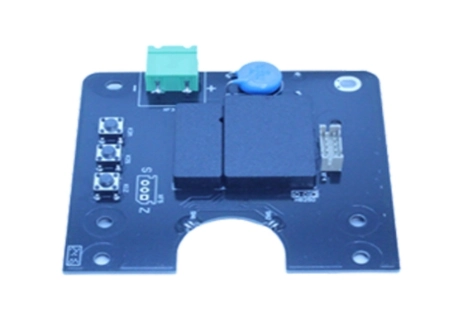
The electrode signal inside an electromagnetic flowmeter is often only a few microvolts or millivolts. At the same time, the circuit may face electrode polarization, ground potential differences, power-line noise, pump vibration, variable-frequency drives, and long sensor cables.
Reliable signal conditioning must recover the useful flow signal without amplifying unwanted interference. This work involves several connected design areas. A good amplifier alone cannot correct poor grounding, unstable power, unsuitable filtering, or weak PCB layout.
Weak Signal Measurement
The input stage needs high input impedance because the sensor may have a high source impedance. It also requires strong common-mode rejection. Otherwise, the larger voltage shared by both electrodes can hide the small differential flow signal.
The amplifier, reference source, and analog-to-digital converter must have low noise and low drift. PCB contamination and moisture also matter. Small leakage currents that seem harmless in ordinary circuits may change the measurement at this signal level.
Noise Filtering
Filtering should reduce electrical interference without making the measurement too slow. Heavy filtering may create a steady display, but it can delay the response during dosing, batching, or rapid process changes.
A reliable flow transmitter circuit combines hardware filtering with digital processing. The filter settings should match the excitation frequency, expected flow response, and surrounding electrical environment.
How Does Excitation Control Affect Accuracy?
An electromagnetic sensor needs a controlled magnetic field. The flow transmitter circuit creates this field by driving current through the excitation coil. Current stability, switching symmetry, frequency, coil resistance, and settling time all influence the final result.
The E4000 uses low-frequency square-wave excitation. Available frequencies are based on fractions of the local power frequency, helping the circuit manage common industrial interference. Its default excitation current is 187.5 mA.
Sensor integration still requires careful matching. For example, the excitation current must suit the sensor coil resistance. A mismatch may weaken the measuring signal, increase heat, or affect long-term stability.
Our E4000 platform supports:
- A 0.1–15 m/s flow velocity range
- A 1 mm/s velocity resolution
- Four-point small-flow correction
- Empty-pipe detection without an extra electrode
- Excitation and excitation-drive alarms
- Forward, reverse, and difference totalizers
These functions support accurate measurement, but the finished flowmeter must be calibrated with its actual sensor.
How Can the Circuit Survive Harsh Industrial Conditions?
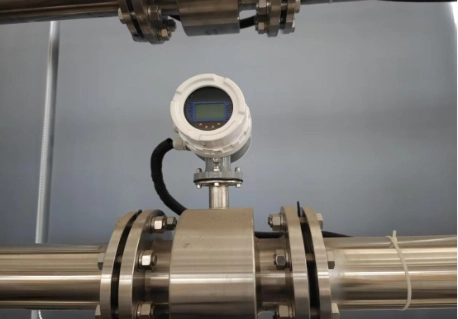
Petrochemical and chemical sites are electrically demanding. Motors, pumps, switching devices, radio equipment, and long cables can introduce noise or transient voltage. Temperature and humidity can also change circuit behavior over time.
A reliable flow transmitter board needs more than accurate components. The whole design must address grounding, shielding, isolation, power stability, heat, protection, and firmware recovery.
Important measures include:
- Separating sensitive analog circuits from switching circuits
- Providing isolation between measurement and output sections
- Protecting inputs and outputs from transient voltage
- Controlling current return paths on the PCB
- Storing calibration data safely
- Recovering parameters after a power or communication fault
- Testing the module across its rated temperature range
The E4000 supports parameter backup and recovery, which helps protect configuration data. Its pulse and frequency outputs use electrical isolation rated above 1000 VDC. However, the OEM must still test the complete instrument for electromagnetic compatibility and field wiring conditions.
More information about the relationship between a sensor and transmitter electronics is available in our guide to flow transmitter circuit integration.
What Makes Hazardous-Area Design Different?
Applications involving flammable gases, vapors, or dust need special attention. A hazardous area is not made safe by adding one protected component. Safety depends on the complete equipment design.
The flow transmitter circuit can support a safer architecture through isolation, controlled power, fault diagnostics, and suitable interface design. Nevertheless, a bare board should not be described as an explosion-proof or intrinsically safe flowmeter.
The finished instrument manufacturer must consider:
- Enclosure protection
- Surface temperature
- Energy limitation
- Creepage and clearance
- Cable entries and terminals
- Power supply faults
- Sensor and output wiring
- Regional certification requirements
The same boundary applies to corrosive liquids. The board processes the measurement, but chemical compatibility comes mainly from the sensor liner, electrodes, seals, and other wetted parts. Those materials must be selected for the exact chemical, concentration, and temperature.
How Does the E4000 Support OEM Customization?
Different instrument manufacturers use different sensors, power systems, displays, and communication interfaces. A fixed flow transmitter circuit may force an OEM to redesign other parts of the meter. A configurable module provides more freedom.
Our E4000 series supports 85–305 VAC or 18–30 VDC power options. Available outputs include 4–20 mA, frequency, pulse, RS232/RS485 communication, Modbus RTU, and optional HART communication.
Customization may cover:
- Active or passive output
- Pulse or frequency configuration
- Communication requirements
- Display language
- Sensor excitation matching
- Alarm behavior
- Parameter settings
- Integrated or split installation
Before recommending a board configuration, we need the sensor coil resistance, pipe diameter, target flow range, power supply, output type, ambient conditions, and required response time. Our article on selecting a flow transmitter board explains these factors in greater detail.
Conclusão
Designing a reliable flow transmitter board requires close control of weak signals, coil excitation, interference, isolation, calibration, diagnostics, and communication. These demands become more serious in petrochemical plants and processes involving corrosive liquids, toxic media, or hazardous-area installations.
An electromagnetic flowmeter provides a suitable starting point for many conductive-liquid applications, but the sensor is only one part of the measuring system. The flow transmitter circuit is the electronic core that turns the sensor response into useful process data.
At ICwalk, we provide the E4000 board for OEM integration rather than a complete flowmeter. Instrument manufacturers can combine our electronics with their own sensor, wetted materials, enclosure, certification plan, and application knowledge. This division creates a clearer and more flexible development path.
FAQs
Q: Can the E4000 display flow in liters?
A: Yes. The configured instrument can display flow rate and accumulated liters.
Q: Can it calculate kilograms directly?
A: Mass in kilograms requires valid density data and suitable system configuration.
Q: Is the flow transmitter board a complete flowmeter?
A: No. It requires a matched sensor, housing, calibration, wiring, and final certification.


